


What is mandatory e-invoicing?
E-invoicing is becoming a hot topic for everyone who issues or receives invoices. For finance departments and company management, it is becoming a matter of regulatory compliance, process readiness, and integration with accounting and ERP systems. The European ViDA (VAT in the Digital Age) framework was adopted in 2025, and by 2030, electronic invoicing and digital transaction reporting are expected to be the standard across the entire EU.
This change is driven by legislation, not choice. The difference won't be in who it affects, but in how smoothly a company navigates it. At INFOMATIC, we approach e-invoicing as part of the entire financial process of handling accounting documents: from receiving/issuing invoices and data validation to exception workflows, ERP integration, and audit trails.
We are ready to handle the e-invoicing mandate for you.
.avif)
Why address mandatory
e-invoicing now?
Mandatory e-invoicing is a response to tax evasion, fragmented regulations, and the fact that in the digital age, we are still working with PDF invoices that require manual processing.
The principle is simple: the invoice shifts from a human-readable document to a structured data message. ERP systems, workflows, and government authorities can process it automatically, leading to fewer errors and faster processing for companies.
For companies in the Czech Republic and Slovakia, this means one thing: it does not pay to wait. E-invoicing impacts your master data, communication with suppliers, approval rules, archiving, and ERP systems. At the same time, even currently digitized processes for receiving paper and PDF invoices must be adapted to accommodate the introduction of e-invoicing.
When will e-invoicing become mandatory?
Germany
January 1, 2025
Slovakia
January 1, 2027
EU
July 1, 2030
What is changing in the EU, Slovakia, and what are the implications for the Czech Republic?
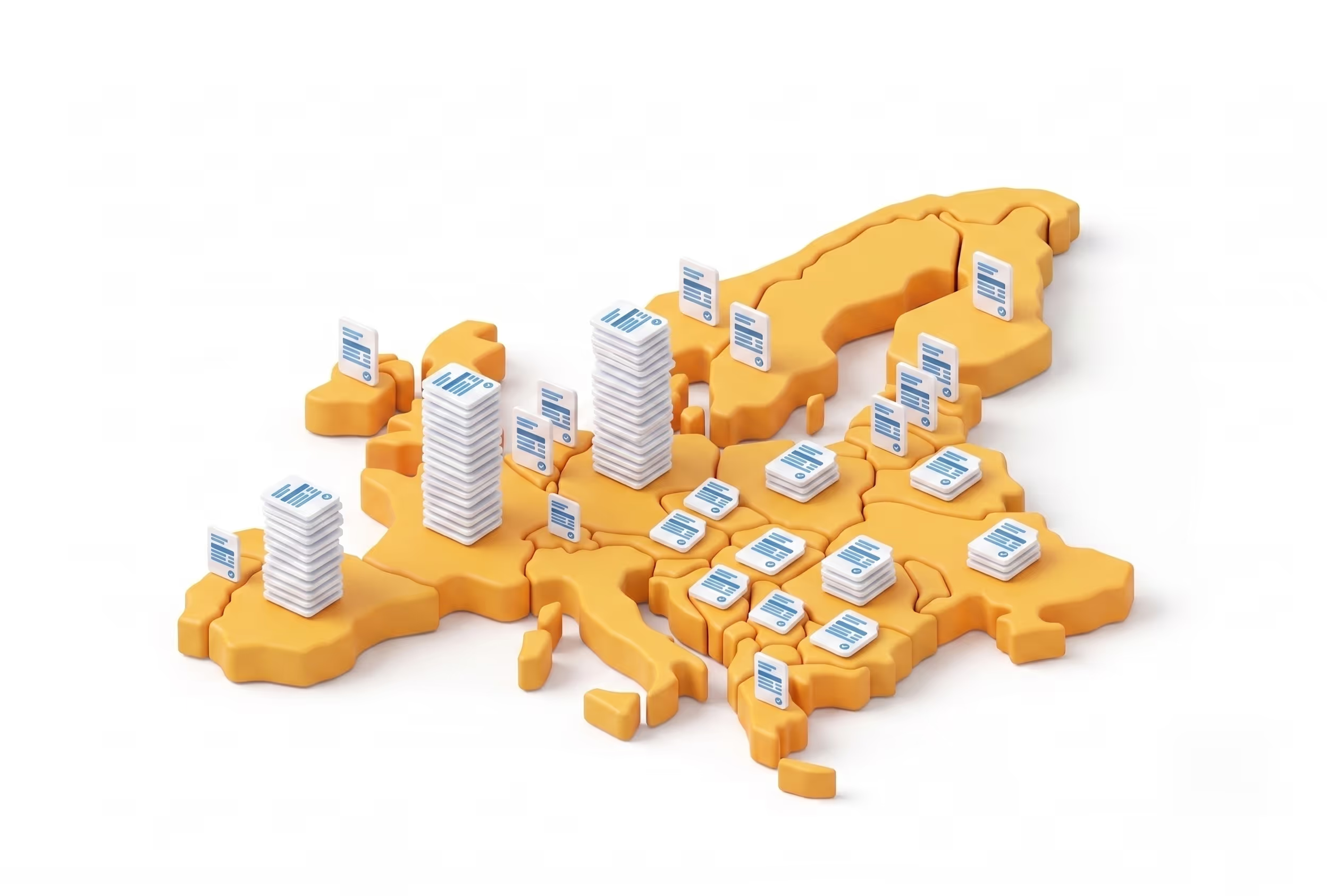
Cross-border B2B reporting in the EU will be firmly based on electronic invoicing (the ViDA framework) starting in 2030. In Slovakia, the mandate begins as early as January 1, 2027, with the system utilizing XML standards and the Peppol network.
In the Czech Republic, legislation will soon adapt—so companies with ties to other countries have no time to waste. Especially since Germany introduced e-invoicing as of January 2025* and Poland has implemented its national KSeF mandate. You need to start addressing the development of your integration layer today.
What does this mean for the CFO, CEO, and the accounting team?
It is not just about fulfilling a new obligation—"knowing how to issue an XML invoice." E-invoicing fundamentally changes four areas with a direct impact on finance and company operations.
Compliance and data accuracy
Invoices must undergo checks for format, mandatory requirements, tax rules, and potentially specific validations according to the legislation of individual countries. Modern technology is capable of performing these checks directly at the point of entry without human intervention.
ERP and accounting integration
E-invoicing only works well when it is properly connected to accounting, workflows, and master data. INFOMATIC has long built solutions as end-to-end processes integrated with ERP systems, rather than as isolated "reading modules" for invoice extraction.
Exceptions and human oversight
Even a well-automated process is not 100% free of exceptions. That is why it makes sense to design a process that involves human oversight, where the system automatically handles standard cases and the accounting team only addresses ambiguities, discrepancies, and exceptions.
Audit trail and risk management
Finance departments need to know where a document is, who has worked on it, what checks have been performed, and when the data was passed on. Control mechanisms are essential for mandatory communication with government authorities.
How does INFOMATIC approach e-invoicing?
Our approach
At INFOMATIC, we don't view e-invoicing as just another IT project, but as a comprehensive transformation for finance, procurement, and ERP operations. Our approach is built on the principle of "digitalization for people," which drives our main priorities, including:
- User adoption and natural integration into processes
- Professional training employees
- Continuous and long-term support
Tungsten Automation technology
We build client solutions on the Tungsten Automation ecosystem, where INFOMATIC acts as a strategic partner. For invoicing, we primarily use the InvoiceAgility and TotalAgility platforms, which are used for automating invoice receipt and issuance, advanced workflows, validation, and process orchestration. These technologies also serve as an access point for the global Peppol network.
Global networks
and Peppol
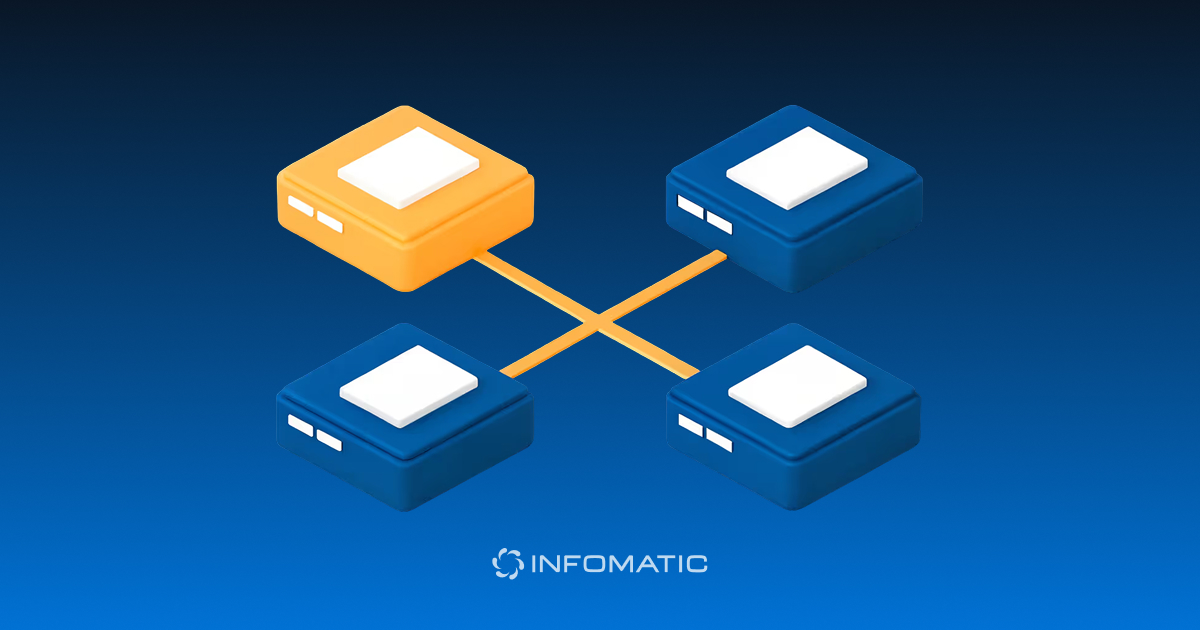
Beyond internal workflows, a reliable network layer for document exchange with partners, supplier onboarding, and cross-border compliance is essential. That is why we utilize the Tungsten e-invoice Network with integration into the preferred European Peppol network. This digital network securely connects suppliers with financial institutions and currently links hundreds of thousands of entities.
Processing all formats
Experience shows that companies do not live in a world of pure e-invoicing and constantly deal with various types of documents. Our technology unifies all formats into a single input layer, applies country-specific validation rules, and connects them to your ERP. We support the following inputs:
- PDF invoices
- Scanned documents
- Structured electronic EDI invoices
Approach e-invoicing as a process transformation, not just another IT task
We will design a solution that integrates seamlessly into your existing operations and stands the test of future legislative changes. From initial process analysis and workflow design to integration and long-term support, we ensure everything is technically and legally sound.
What should an e-invoicing solution cover?
An e-invoicing solution should go beyond simple format conversion. It should cover the entire process:
- invoice receipt from various channels,
- invoice issuance (domestic and cross-border)
- control format, content, and tax rules,
- workflow for approvals, exceptions,
- integration into ERP and related systems,
- solution cross-border invoicing between countries,
- archiving, an audit trail, and reporting.
This end-to-end approach gives CFOs and chief accountants exactly what they need:
- less manual work
- lower error rate,
- better overview of document status and
- smaller operational risk during legislative changes and predictable cash flow.
Why not wait until the deadline?
The hardest part of e-invoicing is usually not the technology itself. It is typically organizational readiness. The success of automation depends on data quality, clean processes, and clearly defined goals; you cannot layer intelligence onto an unclear and unmanaged process.
When a company starts in time, it has the space to adjust approval rules, prepare data mapping, coordinate with suppliers and customers, set responsibilities, and test integrations without unnecessary pressure. The result is not just legislative compliance, but also a genuinely improved financial process.
.avif)
Frequently Asked Questions
Here you will find answers to the most frequently asked questions regarding invoice processing.
No. According to the Czech Ministry of Finance, an e-invoice is a structured electronic format that allows for automated processing and complies with the EN 16931 standard. A PDF may be a digital document, but it does not, by itself, meet the definition of a structured e-invoice.
Not necessarily. The goal is to supplement your ERP with a layer for receipt, validation, workflow, and integration. INFOMATIC has long built solutions specifically as a bridge between document and process technologies and ERP or other enterprise systems.
That is a common situation. The technology behind these solutions is designed to handle the unified receipt of PDFs, paper, and e-invoices within a single platform, so a company doesn't have to run separate processes for each input type. When processing cross-border invoices, it is important to be prepared for all formats.
Yes, it makes sense, especially for companies operating internationally, handling cross-border trade, high invoice volumes, or complex approval processes. The European timeline is well-known, and many countries have already implemented a system or have a set deadline. Early preparation reduces pressure on both finance and IT departments. This is the practical conclusion based on current developments within the EU.
Have any questions?
I am here to help
Kamil Dobřemysl
Account Manager
