

Tungsten TotalAgility
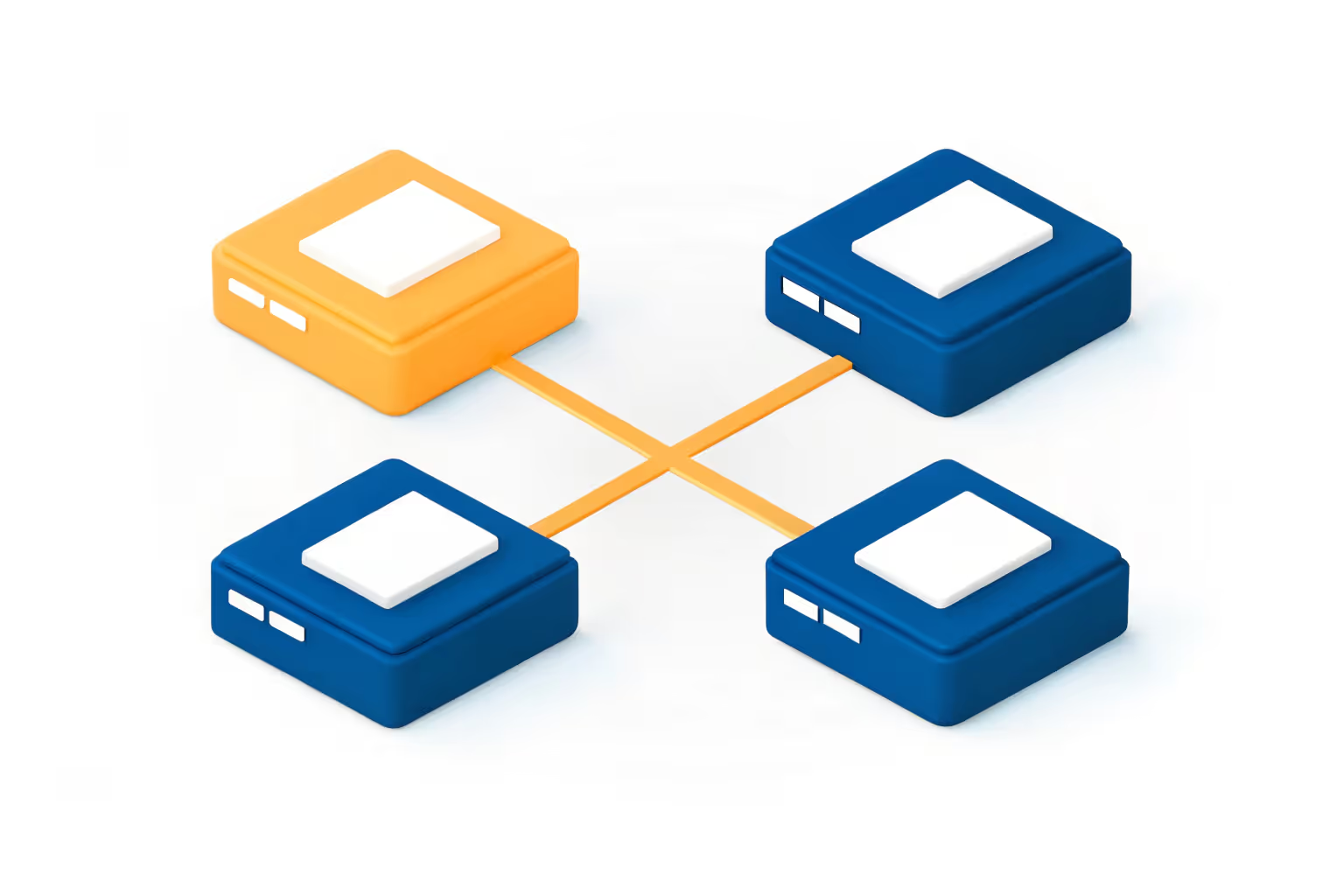
Tungsten TotalAgility is an AI-driven low-code platform for end-to-end process automation and building process applications. It combines intelligent document processing (IDP), process orchestration, and integration capabilities into a single managed solution. It helps you process documents and requests from various channels, manage approvals and exceptions, and connect your entire workflow with internal systems. The result is faster operations, fewer manual steps, and better visibility into what is happening across your business.
End-to-end process orchestration
Design and manage your entire workflow: tasks, roles, exceptions, and escalations—without the need for manual adjustments across different tools.
Document recognition and understanding
Using OCR and AI (including NLP/ML), the platform can understand both structured and unstructured content and convert it into data that directly feeds into application logic and process management. In some scenarios, it also includes speech-to-text or sentiment analysis. The output is structured data ready for the next steps of the process.
Low-code application and form development
Visual process and screen design enable rapid prototyping, adjustments, and deployment. Minimum code, maximum control over logic and rules. The platform supports rapid prototyping, iteration, and deployment of process applications without the need for traditional development for everything.
Integration and scaling without blind spots
APIs, connectors, and the option to combine API + RPA for systems without interfaces are available. Monitoring and dashboards (Tungsten Insight) + data export to your BI.
How TotalAgility works in practice
Automation that delivers real impact doesn't stop at a single step. In real-world operations, you need to capture inputs, understand content, make decisions based on rules, manage exceptions, assign work to the right people, and write results to internal systems—repeatably, securely, and with an audit trail.
TotalAgility is designed for content-heavy workflows where you need to work with documents, data, and decision-making across systems. It doesn't solve individual steps in isolation; instead, it combines AI-driven IDP, process orchestration, application logic, rules, integration, and analytics into one managed entity. This allows you to build digital applications and processes that match how your organization actually functions. The TotalAgility platform is designed to digitize and manage end-to-end processes—which is why it combines intelligent document processing (IDP), process logic (workflow/BPM), rules, tasks, integrations, and analytics into a single platform.
What the platform can do:
Intelligent Document Processing (IDP)
Automatically digitizes, classifies, and extracts data from documents. It uses OCR and AI (including NLP/ML) as needed and can also work with unstructured content.
Process, task, and rule management
A robust process platform: Task Automation, Rules Management, Case Management. You can set up rules in a low-code interface using an integrated rule engine.
Frontend applications
Rapid prototyping and deployment thanks to a visual development environment, responsive UI, and the ability to improve UX and use analytics for optimization.
Integration with internal systems
DMS/ERP/CRM typically via APIs and connectors; for legacy systems, you can combine API and RPA.
Analytics and monitoring
Tungsten Insight for operational dashboards + structured data ready for export to BI.
We can extend the platform according to your needs, for example with:
AI & NLP: integrated tools for creating LLM and NLP models and using AI in automation
Tungsten RPA: automation of simple processes / connecting legacy systems
Tungsten SignDoc: biometric signature on mobile, tablet, or PC
Tungsten Communication Manager: generating documents and content directly from the process
Tungsten Mobile: mobile document scanning, small file sizes, biometric verification
The architecture is designed for flexible deployment in an on-premise environment or in the cloud.
Input capture
The platform captures inputs from various channels—documents, forms, portals, internal applications, and emails—and assigns them to the correct process or application context. From the very first step, it is clear which workflow is being triggered and which rules apply.
Intelligent document processing
TotalAgility digitizes, classifies, and extracts data from documents. Depending on the scenario, it works with both structured and unstructured information using OCR + NLP/ML/AI. It then prepares structured data that the process can continue to work with (workflow, rules, integration).
Process orchestration
Within the workflow, you set up steps, responsibilities, and rules (integrated rule engine). The system creates tasks, monitors process logic, and can manage even complex scenarios through case management.
Integration, outputs, and analytics
It delivers results to target systems (DMS/ERP/CRM) via APIs/connectors; for legacy applications, a combination of API + RPA can be used. Operational management is handled by monitoring and dashboards (Tungsten Insight), as well as exports to BI.
Where is our solution used?



Frequently Asked Questions
Here you will find answers to the most frequently asked questions regarding Tungsten TotalAgility.
Most often end-to-end processes: finance (AP/AR scenarios, orders, claims), back-office agendas, digital mailrooms, HR (onboarding, requests), customer inquiries, and service and approval workflows. Anywhere you have a mix of rules, exceptions, and multiple systems.
The visual design of processes, screens, and rules is low-code. For more complex integrations, specific validations, or enterprise governance, development is typically required – but a large portion of changes and iterations can be done without complex programming.
Primarily via APIs and connectors. If a system lacks an API (or it is impractical to use), a combination of API and RPA can be chosen to keep the process end-to-end without the need for manual intervention.
Both are possible. The choice depends on security and compliance requirements, integrations, operational preferences, and IT standards. In practice, the decision is often driven by connectivity to internal systems and the identity and access management regime.
Typically a combination of processing volume (e.g., thousands to hundreds of thousands of documents per year, depending on the edition) and the number of users and roles (full users vs. participants – for approvals and filling out forms). Specific parameters are set based on the scenario, input channels, required intelligence (IDP), and environment (prod/test/dev).
Space for another question
Have any questions?
I am here to help
Jiří Plešek
Senior Sales Manager
